


When you first hang a new piece, there's a moment of assessment. You step back, tilt your head slightly, and ask yourself if it's right. If the colour works. If it feels how you imagined. And in that moment, you're seeing one version of the artwork. A single snapshot in time.

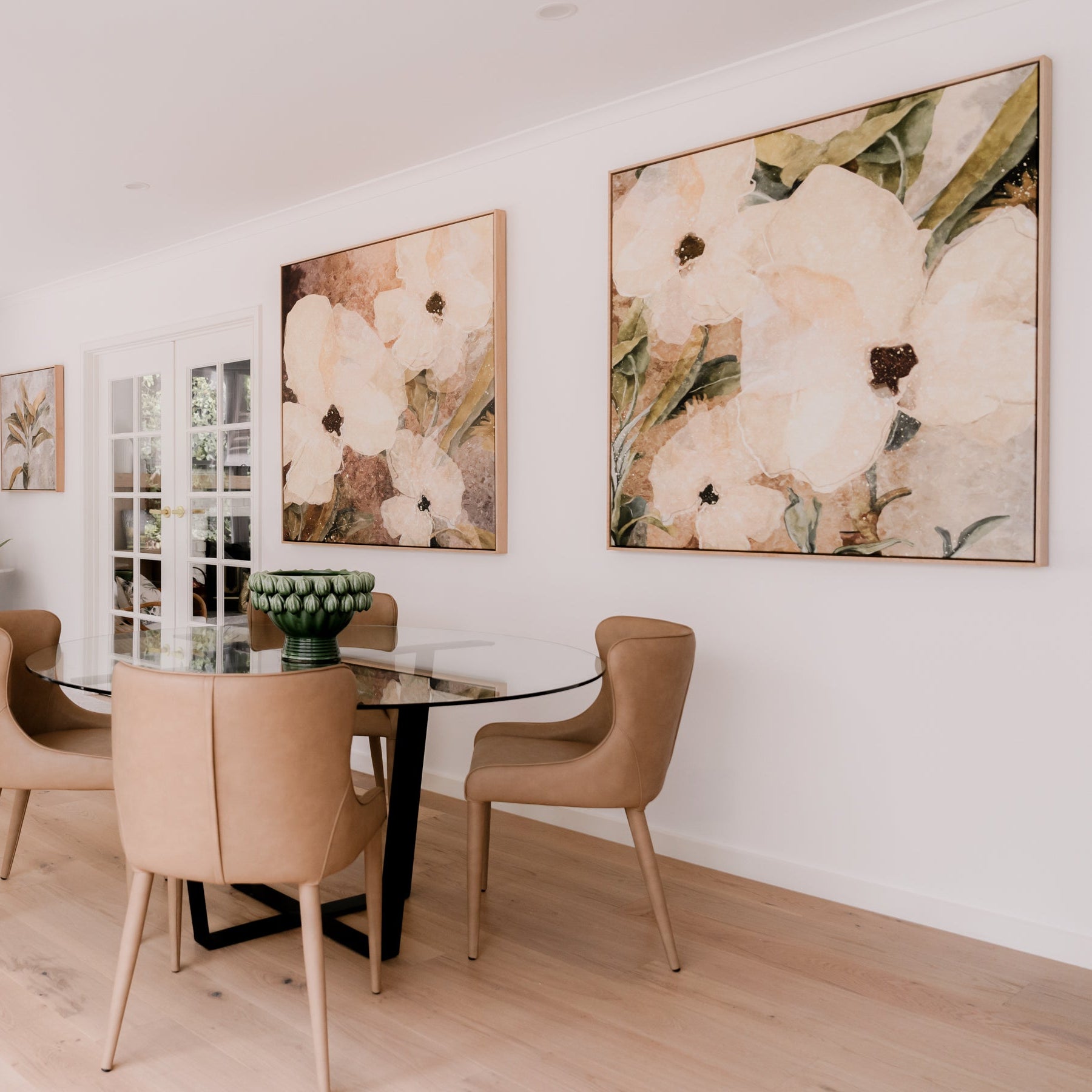
"Monteverde" - Square on Canvas
But here's what I've come to appreciate about living with art rather than simply choosing it: the piece you hang on Monday morning isn't quite the same piece you see on Thursday evening.
Light has a way of completely changing how colour is perceived. Not in a problematic way. In a revelatory way.
I've watched pieces shift throughout the day in our Gold Coast home, and every time it happens, I'm reminded why this matters. Morning light here is soft and golden, filtering through with a warmth that brings out the deeper tones in a piece. Those earthy ochres and soft terracottas that might have felt subtle on screen suddenly glow. By midday, when the light is bright and direct, the same artwork reads differently. Cooler. Clearer. More defined.

"Margaret River Rocks" - Square on Canvas
And then evening arrives, and everything softens again. Shadows deepen. Certain colours recede while others come forward. Details you didn't notice in the morning reveal themselves in the fading light.
This isn't a flaw in the artwork. It's not a failure of photography or screen calibration. It's the nature of living with something that responds to its environment. And honestly, it's one of the most beautiful parts of choosing art.

"Cable Beach" - Portrait on Canvas
I think we've been conditioned to expect certainty before we commit. We want to know exactly how something will look, exactly how it will feel, before we allow ourselves to bring it home. But art doesn't work that way. It settles in over time. It reveals itself gradually. And the colours you weren't sure about on day one often become the ones you love most by day seven.
Screens can only show you a fixed version of a piece. One light temperature. One moment. But in your actual space, with your actual light, the artwork becomes dynamic. It shifts with the day. It changes with the seasons. It responds to how you move through your home and when you pause to really look.
That's not something to be anxious about. That's the entire point.
When someone reaches out worried about colour accuracy, I understand the hesitation. Buying art online requires a different kind of trust than seeing it in person. You're working with images on a screen that may show colours slightly warmer or cooler depending on your settings, your lighting, whether you're viewing in night mode or full brightness. We're never going to be able to have colours exactly represented on screens. It's always going to look slightly different in real life.
But that difference isn't a problem to solve. It's an invitation to experience the work as a living thing rather than a static image.

Gallery Collectibles are available this month only - Strictly limited edition pieces.
Closeup featured - Eos Terra Gallery Collectible.
I've learned to trust tone over exact colour. If a piece feels right in terms of warmth or coolness, depth or lightness, it will work. The specific shade of terracotta or the precise hue of soft green matters far less than whether the overall feeling aligns with your space. And you won't know that from a screen. You'll know it after a week of living with it, watching it shift and settle, discovering new details you didn't see at first.
This is the fun of buying art. The slow reveal. The way a piece becomes more familiar and somehow more interesting at the same time. The mornings when the light catches it just right and you see something you've never noticed before, even though it's been hanging there for months.
So if you're circling a piece but hesitating because you can't be 100% certain how it will look in your space, I'd offer this: certainty isn't the goal. Connection is. And connection deepens with time, with light, with the everyday act of living alongside something beautiful.
The piece you're considering will look different in your home than it does on your screen. It will look different in morning light than it does in evening light. And that's not a limitation. That's exactly what makes it worth bringing home.





Leave a comment